

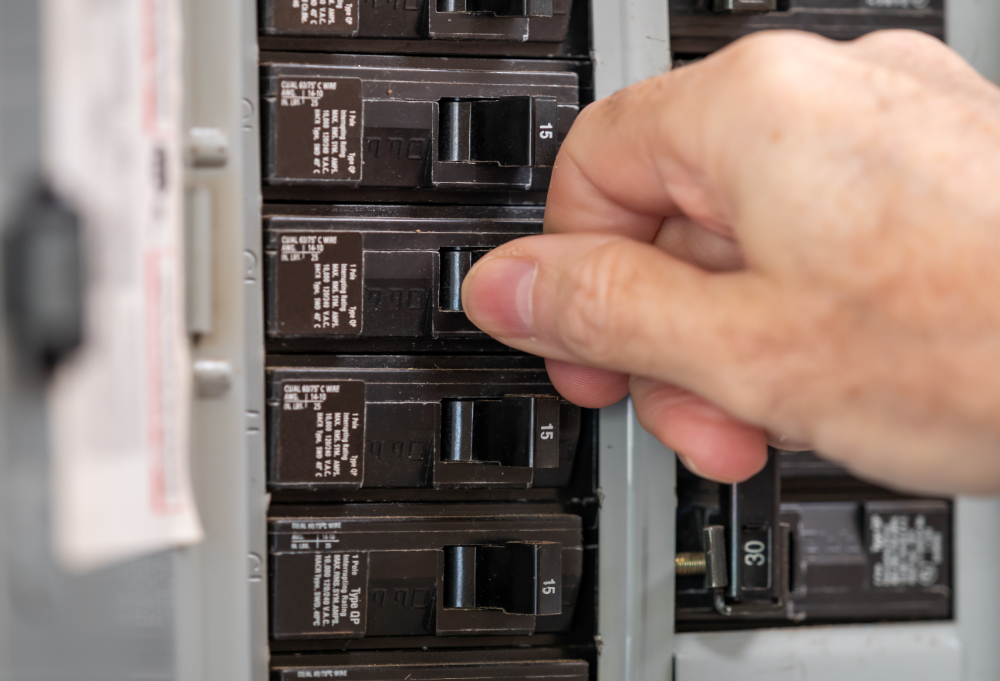
Summer in Southern California brings long sunny days, backyard gatherings, and the constant hum of air conditioners working overtime. But for many homeowners and business owners, it also brings a frustrating and sometimes alarming problem: circuit breakers that keep tripping. If you have found yourself repeatedly resetting the same breaker during the hottest months of the year, you are not alone, and more importantly, you should not ignore it.
Understanding why this happens, and when it crosses the line from a minor nuisance into a genuine safety hazard, can protect your property and your family.
The Summer Surge: Why Heat Puts Extra Demand on Your Electrical System
The relationship between summer heat and electrical problems is more direct than most people realize. When temperatures climb into the triple digits, as they often do in the Inland Empire, every cooling device in your home or business kicks into high gear. Air conditioners, fans, refrigerators, freezers, and dehumidifiers all draw significantly more power during peak heat periods. This surge in demand puts enormous strain on your electrical circuits, often pushing them past their designed capacity.
Circuit breakers are designed to trip when a circuit draws more current than it can safely handle. This is a protective feature, not a flaw. When your AC unit fires up at the same time as your dishwasher, your dryer, and three window units in the bedrooms, the total load on a single circuit or even on your main panel can exceed safe thresholds. The breaker trips to prevent overheating, which could otherwise lead to an electrical fire.
For businesses that rely on commercial electrical services, the problem can be even more pronounced. Commercial kitchens, retail spaces with heavy lighting loads, and office buildings running dozens of computers alongside central air conditioning systems face compounding demands that can overwhelm aging infrastructure. Summer is consistently the busiest season for electrical service calls precisely because systems that barely kept up through spring simply cannot handle the added thermal and electrical stress.
The Hidden Culprit: Heat Itself Weakens Electrical Components
Beyond the increased demand from appliances and cooling systems, heat has a direct physical effect on the components inside your electrical panel and throughout your wiring. Copper wiring expands when it heats up. Over years of repeated expansion and contraction through seasonal cycles, connections can loosen. Loose connections create resistance, resistance generates heat, and heat accelerates the deterioration of insulation around wires.
Inside your breaker panel, the breakers themselves are mechanical and thermal devices. Their internal components are rated for specific temperature ranges. When the ambient temperature inside a panel enclosure rises, which it does when it is installed in an attic, a garage, or on an exterior wall that bakes in direct sunlight, the breakers can begin to trip at lower loads than they were designed to handle. This is called thermal nuisance tripping, and it can give homeowners a false sense that the problem is minor when the underlying cause is actually a degraded panel that needs professional attention.
This is exactly the kind of situation where scheduling summer electrical services with a licensed electrician matters. A professional inspection can identify whether your panel is running hot, whether connections have loosened, and whether your current infrastructure is adequate for your cooling load.
Overloaded Circuits vs. Faulty Breakers: Knowing the Difference
Not every tripping breaker means the same thing. There is a meaningful difference between a breaker tripping because a circuit is genuinely overloaded and a breaker tripping because the breaker itself is failing. Knowing which situation you are in changes what you need to do next.
An overloaded circuit is the most common summer scenario. You plug in a portable AC unit in a bedroom that already runs a desktop computer, a TV, and a lamp. The total draw exceeds the circuit’s rated capacity, and the breaker trips. The solution might be as simple as redistributing appliances to different circuits, or it might require a licensed electrician to add a dedicated circuit for high-draw appliances.
A faulty breaker is a different matter entirely. If a breaker trips repeatedly even under light loads, if it feels warm or hot to the touch, if you notice a burning smell near the panel, or if the breaker will not stay reset, you may be dealing with a breaker that has reached the end of its service life. Breakers are not designed to last forever. They degrade over time, especially in environments where they are regularly pushed to their limits. Replacing a worn breaker is a straightforward job for a licensed electrician, but it is not a DIY task. Working inside an energized panel carries serious risks of arc flash and electrocution.
For both homeowners accessing residential electrical services and business operators using commercial electrical services, having a professional evaluate a repeatedly tripping breaker is the safest course of action.
When Tripping Breakers Signal a Serious Safety Risk
Most people treat a tripping breaker as an inconvenience. You reset it, move on, and forget about it until it trips again. But there are circumstances where a tripping breaker is warning you about something that could cost you your home or your life.
If you notice scorch marks or discoloration around any outlet or switch on the circuit that keeps tripping, that is a sign of arcing, which means electricity is jumping across a gap where it should not be. Arcing is one of the leading causes of residential electrical fires. Similarly, if you smell something burning near your breaker panel, even faintly, treat it as an emergency. Call an electrician immediately and avoid using the affected circuit until it has been inspected.
Old wiring is another serious risk factor. Homes built before the mid-1970s may have aluminum wiring, which is far more prone to loosening at connections and creating fire hazards than modern copper wiring. Homes from the same era may also have Federal Pacific or Zinsco panels, two brands that have been widely documented to have defective breakers that fail to trip when they should, or that arc internally. If your home has one of these panels, summer is a critical time to have it evaluated and replaced. This is one of the most important investments you can make through residential electrical services.
GFCI and AFCI breakers add additional layers of protection in modern homes, but older homes often lack them entirely, especially in kitchens, bathrooms, garages, and outdoor circuits. A licensed electrician providing summer electrical services can assess where these protections are missing and bring your home up to current code standards.
What You Should Do Before the Heat Gets Worse
The best time to address electrical concerns is before the peak of summer, not in the middle of a heat wave when electricians are booked out for weeks. There are several proactive steps you can take now to reduce the risk of electrical problems during the hottest months.
Start by identifying which circuits are most heavily loaded during summer. If the same breaker trips repeatedly, note what appliances are running when it happens. Avoid running multiple high-draw appliances on the same circuit simultaneously. If your home or business regularly needs more capacity than your current panel provides, talk to a licensed electrician about a panel upgrade or load balancing.
Schedule a professional electrical inspection as part of your summer preparation. A thorough inspection through a provider of summer electrical services can identify aging components, loose connections, undersized wiring, and panels that are approaching the end of their useful life. For commercial properties, this kind of inspection is especially valuable because downtime caused by an electrical failure during peak business season can be costly.
Do not rely on extension cords or power strips as permanent solutions to circuit overloads. They are a short-term convenience that often becomes a long-term fire risk, especially when high-draw appliances are involved.
Stay Cool and Stay Safe This Summer
A tripping breaker is your electrical system trying to communicate with you. Sometimes the message is simple: too many appliances on one circuit. But sometimes it is pointing to something more serious, something that deserves immediate professional attention. Whether you need residential electrical services for your home or commercial electrical services for your business, working with a licensed local electrician is the most reliable way to make sure your electrical system can handle the demands of a Southern California summer safely and efficiently.
Need Electrical Panel Replacement & Electrical Services Near You?
At Pi Electric and Solar, we’re passionate about helping you power your home or business with reliable, sustainable energy solutions. Whether you’re ready to modernize your electrical systems, explore smart home options, or make the switch to solar, our expert team is here to guide you every step of the way. Let’s work together to create a seamless, energy-efficient transformation tailored to your needs—reach out to us today and discover how we can make your vision a reality!